

Air Ambulance Services in Dubai
CodBlu Healthcare offers 24/7 medical coordination for patients travelling between Dubai and India. A Dubai air ambulance enquiry starts with the patient’s clinical needs: an escorted airline seat, an approved airline stretcher or a dedicated medical charter may be appropriate. Dubai International Airport (DXB) and Al Maktoum International Airport (DWC) are separate departure options, with different flight and handling arrangements. The plan must connect the patient’s hospital, the accepted aircraft or airline, and the receiving hospital in India, including suitable medical support during both ground transfers.
Call +91 93108 64489 for 24/7 medical coordination.
Does the Patient Need to Leave Dubai Now?
Returning home after hospital treatment is different from needing an urgent transfer for care. Dubai has established hospitals with specialist services. If a patient needs immediate treatment, moving to a suitable local hospital may be more appropriate than waiting for an international flight.
For repatriation, the treating doctor and transport medical team should review the diagnosis, recent observations, breathing support, circulation, ongoing medicines and the risk of deterioration during movement. The assessment must include airport waiting and road travel, as well as time in the air.
A patient recovering after surgery may need help with medicines and mobility. Another patient may require ventilation, continuous infusions or a stretcher throughout the journey. Their transport plans will differ even when both are travelling from Dubai to the same Indian city.
Hospital discharge does not, by itself, establish fitness for commercial flying. Where continued inpatient care is needed, confirm the receiving hospital’s acceptance before arranging departure.
Flying Commercially from Dubai: The Airline Matters
Dubai’s scheduled flights can provide a practical repatriation option for selected stable patients. Commercial air ambulance arrangements use a passenger airline, with medical support approved for that patient and flight. A booked seat alone does not establish that the airline can accommodate the required care.
| Arrangement | When it may be considered | What needs confirmation |
|---|---|---|
| Seated medical escort | A patient can sit safely and needs clinical supervision, medication support or assistance | Appropriate doctor or nurse escort, approved equipment and any medical clearance |
| Business-class medical escort | Extra space may help a suitable patient tolerate the journey | Safe upright positioning for the required flight phases, seat design and airline acceptance |
| Airline stretcher | A patient must remain lying down but can meet the carrier’s medical conditions | Stretcher availability on the specific aircraft, medical approval, escort and boarding arrangements |
Emirates, flydubai and Air India Have Different Requirements
Emirates uses its Medical Information Form (MEDIF) process for relevant medical cases, including requests involving a stretcher, oxygen or certain equipment. Its published guidance calls for completed submission at least 48 hours before travel. That is a submission requirement, not a promise of approval or stretcher availability within 48 hours.
flydubai’s published policy does not accept passengers who require a stretcher, ventilator or incubator during travel. Patients needing oxygen must use an approved portable oxygen concentrator (POC) under its conditions. Where a MEDIF is required, flydubai specifies submission between 15 days and 72 hours before departure. A direct flydubai flight can therefore be unsuitable for a patient whose needs another carrier may assess differently.
Air India requires medical clearance for relevant cases and prior approval for stretcher bookings. Its published document requirements include a medical report issued within 10 days of departure and escort details for stretcher cases. Critically ill patients are generally not accepted on its commercial aircraft; exceptions require case-specific medical, engineering and security clearances. Confirm support throughout all flight phases with the airline before booking.
The operating airline matters, including on a codeshare ticket. A fit-to-fly letter from the treating doctor may be required, but does not replace a carrier’s own acceptance process. If a connection involves another airline, both segments need assessment.
Oxygen and Airport Assistance Need Separate Arrangements
State whether the patient needs continuous oxygen, the prescribed delivery method and the proposed device. Equipment approval, battery reserves and support during boarding must be settled in advance. A POC is not a substitute for every oxygen prescription.
Wheelchair assistance helps with access; it does not provide clinical observation or treatment. Similarly, a reclining business-class seat is not an approved medical stretcher. Choose the arrangement according to the patient’s needs, rather than cabin class alone.

When an ICU Air Ambulance from Dubai May Be Appropriate
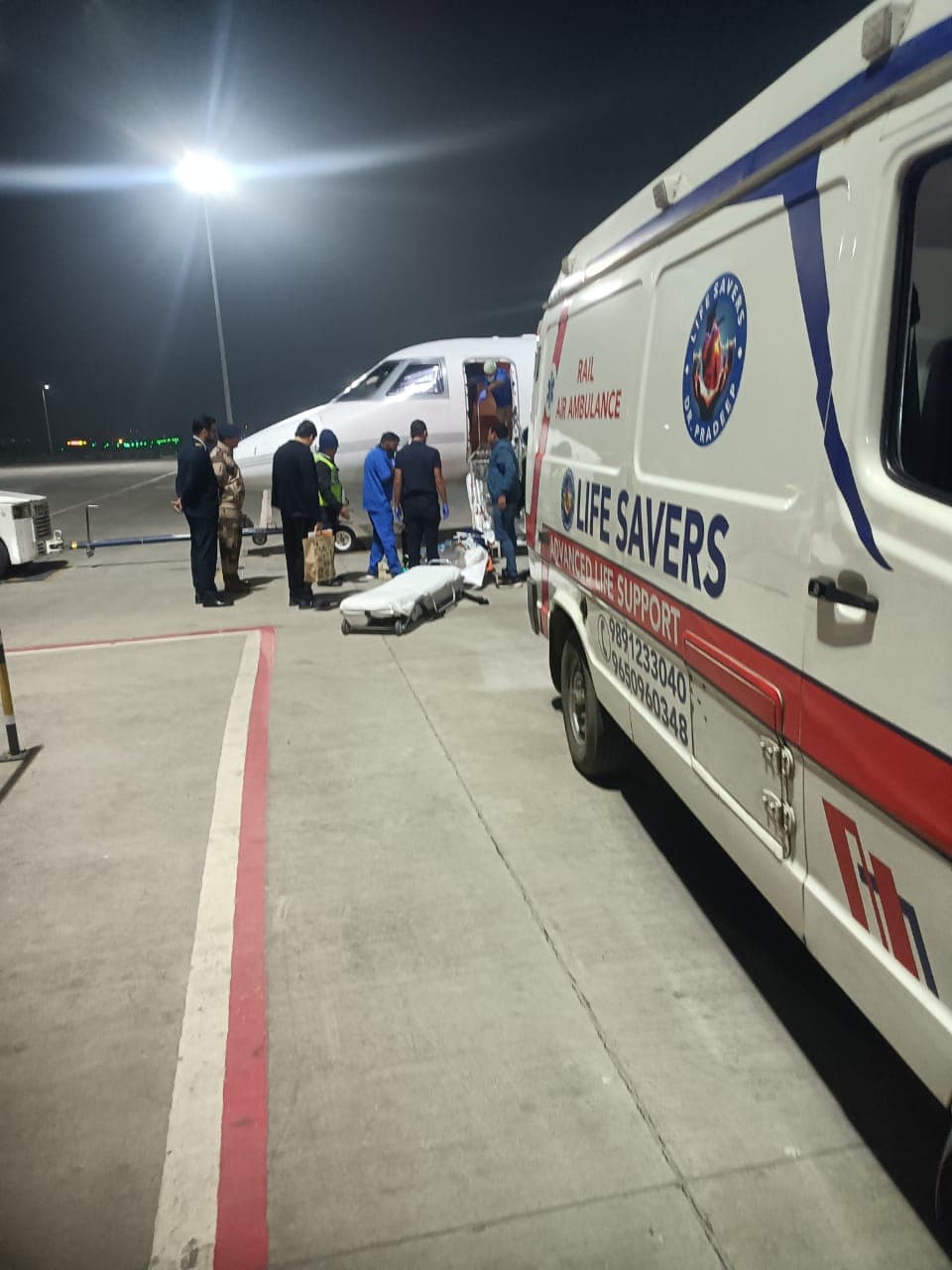
A dedicated charter air ambulance may be considered when the patient needs support that cannot be accommodated on a suitable scheduled flight, or when an airline itinerary would introduce medically difficult waits and changes of vehicle or aircraft.
Selected ICU and ventilator-dependent patients can be assessed for a charter transfer. The medical plan should establish airway security, ventilation needs, oxygen consumption, circulation and the medicines that must continue during movement. The proposed aircraft then needs enough working space and a compatible stretcher and equipment installation.
For example, a patient receiving continuous infusions needs a plan for pump operation and power during loading as well as flight. A ventilated patient needs oxygen and battery reserves that account for delays. An appropriate critical-care team should be selected for the case, with monitoring, suction and emergency support suited to the clinical risks.
CodBlu Healthcare can coordinate charter assessment and the associated medical journey. Actual operation depends on a suitable aircraft operator, crew, configuration and permissions. Aircraft positioning into the UAE may be necessary. Route planning must also account for range, fuel stops where needed, airport slots, handling, crew limits and current operating restrictions.
Before confirming a charter, ask for the name of the aircraft operator and who will provide the clinical team and UAE ground ambulance. These may be different organisations. The written plan should identify the responsibilities of each, the medical configuration and a contact for changes during the journey.
A shorter air sector does not make a medically complex transfer simple. The patient must be ready for the proposed journey before movement begins.
DXB or DWC? Match the Airport to the Confirmed Transport Plan
Dubai International Airport (DXB)
DXB is a major scheduled-flight gateway for India. It can be relevant to commercial medical escorts and accepted airline-stretcher arrangements.
Confirm the departure terminal, operating flight, boarding equipment and ambulance access with the handling team. The patient’s hospital location and current traffic affect when the ground transfer should begin.
Al Maktoum International Airport (DWC)
DWC serves Dubai South and supports general aviation alongside other operations. It may be considered for a medical charter when the operator and handling arrangements allow. For a patient in southern Dubai, the ground route should be compared with DXB before selecting the departure point.
DWC is not interchangeable with DXB on an airline booking. A departure airport cannot be changed simply because it is closer to the hospital.
For patients in Sharjah, Ajman or another emirate, assess the starting hospital and appropriate departure airport rather than automatically bringing them into Dubai. For movement to another hospital within Dubai or a nearby emirate, a suitable ground ambulance may avoid the additional handling involved in flying.
Hospital Location Changes the Dubai Ground Journey
Give the exact hospital and campus when requesting a transfer. The following facilities illustrate different starting areas; they are geographical references, not statements of a CodBlu partnership or guaranteed admission.
| Hospital | Area | Relevance to planning |
|---|---|---|
| Rashid Hospital | Umm Hurair | Specify the ward and discharge team when arranging a pickup in this part of Dubai |
| Mediclinic City Hospital | Dubai Healthcare City | Identify the City Hospital campus rather than another Mediclinic facility |
| Al Jalila Children’s Hospital | Al Jaddaf | A newborn or child’s transfer needs paediatric coordination and receiving-unit acceptance |
| King’s College Hospital London, Dubai Hills Hospital | Dubai Hills | Include the Dubai Hills campus when assessing the ground route |
| NMC Royal Hospital, DIP | Dubai Investments Park 1 | A southern Dubai origin warrants comparison of the confirmed airport options |
Airport access, patient loading and clinical support are part of the ground plan. An ordinary car or a standard patient-transport booking may be inappropriate for someone needing critical care. The ambulance provider must confirm the staff and equipment required for this patient.
Dubai to India: Choose the Receiving Hospital Before the Arrival City
Begin with the intended receiving facility. A non-stop itinerary may avoid another airport handover, provided its carrier can accommodate the required care.
The following published Emirates schedules provide approximate outbound scheduled-flight benchmarks. They are not medical-charter timings or total hospital-to-hospital transfer times.
| Route from DXB | Approximate published flight duration | Decision to make |
|---|---|---|
| Dubai to Mumbai (BOM) | Around 3 hours 10–15 minutes | Confirm the receiving hospital and Mumbai ground route |
| Dubai to Delhi (DEL) | Around 3 hours 25–40 minutes | Specify the actual hospital in Delhi NCR, including its campus |
| Dubai to Kochi (COK) | Around 4 hours–4 hours 5 minutes | Check whether Kochi is the intended treatment destination or requires a further transfer |
Schedules and aircraft change. A published passenger route does not establish stretcher availability, medical acceptance or a seat on the required date.
Other Indian destinations can be assessed according to the receiving hospital and current route options. Where a connection is proposed, consider extra boarding, medical clearance for each operator, equipment compatibility and the support available during the stop. Compare this with charter routing where clinically appropriate.
Patients travelling from India to Dubai need the same clinical assessment, plus confirmation of the receiving Dubai hospital, applicable entry documents and financial arrangements for admission.
Preparing a Newborn or Child for Repatriation
For neonatal and paediatric air ambulance enquiries, share the child’s age, weight, diagnosis and respiratory support, together with the referring clinician’s advice. Confirm acceptance by the destination NICU or PICU where that level of care is required.
A baby needing an incubator transfer requires compatible loading, temperature management and respiratory support across the road and air stages. Neonatal monitoring, suitably sized airway equipment, pumps and specialist staffing should be planned around the individual case. An adult medical setup cannot simply be assumed suitable for a small child.
Airline age and medical restrictions also apply. A routine infant ticket does not establish approval for a premature or unwell newborn. The transport team must confirm the proposed aircraft or carrier can accommodate the child’s actual needs.

Add CodBlu Healthcare as a Preferred Source

Air Ambulance Cost from Dubai to India
International medical-transfer prices may be quoted in US dollars (USD) or UAE dirhams (AED). For initial budgeting, the table below shows published India–Middle East reference prices in USD, reviewed on 1 October 2026.
They describe regional transport categories, not confirmed Dubai flight prices or CodBlu tariffs. The source does not establish when these prices were last updated.
| Transport category | Published reference price (USD) | Scope of the reference |
|---|---|---|
| Business-class commercial medical transfer | 3,000–6,000 | India–Middle East regional tariffs; final escort, fare and equipment arrangements need confirmation |
| Commercial airline stretcher | 12,000–18,000 | India–Middle East tariffs vary by Indian region; carrier acceptance and installation are separate requirements |
| Mid-sized medical charter jet, North India | 45,000–55,000 | North India–Middle East sector reference |
| Mid-sized medical charter jet, West India | 50,000–70,000 | West India–Middle East sector reference |
| Mid-sized medical charter jet, South or East India | 65,000–75,000 | South/East India–Middle East sector reference |
These are planning references, not minimum prices or guaranteed quotations. A particular Dubai transfer may fall outside them. Larger aircraft, more complex care or different positioning can produce a substantially different price.
For a charter departing Dubai, confirm where the aircraft is based. An aircraft already suitably positioned in the UAE may have a different quotation from one that must first fly in to collect the patient. Aircraft category, routing, fuel and operating conditions, medical team, oxygen or ventilator support, handling and both ground ambulances also affect the total.
For commercial travel, check patient and escort tickets, cabin class, stretcher seat blocks, approved equipment and boarding support. Business-class seating and an installed airline stretcher are different arrangements.
Ask for an itemised quotation identifying the hospitals, airports, currency, included services, taxes and validity. Clarify charges for relatives, waiting, escort accommodation, cancellation and changes in the patient’s condition. Receiving-hospital treatment costs should be identified separately unless expressly included.
A suitable commercial arrangement may cost substantially less than charter, but price cannot establish medical suitability. CodBlu Healthcare’s actual price is confirmed after clinical review and a current operational quotation.
Insurance and Documents for Medical Repatriation from Dubai
For international medical repatriation, contact the insurer or assistance company early. Ask whether the policy covers medical evacuation or repatriation, what pre-authorisation is required and whether payment will be made directly or reimbursed.
Medical recommendation alone does not confirm cover. Obtain written confirmation of authorisation or a guarantee of payment where applicable.
Useful documents usually include the patient’s passport, applicable visa or travel permissions, recent clinical summary, investigations, medication details and the receiving hospital’s confirmation. Add the airline’s medical forms and equipment approvals where required. Requirements depend on nationality, route and transport mode.
Indian nationals who cannot meet repatriation expenses may enquire with the Consulate General of India in Dubai about financial assistance. Its Indian Community Welfare Fund process is means-tested and assessed case by case. Assistance is not automatic; the consulate determines eligibility and supporting documents.

What Bed-to-Bed Coordination Should Cover
For a confirmed Dubai–India transfer, the journey should be organised as one clinical plan:
Review the latest condition with the treating team, confirm acceptance at the receiving facility and settle the transport configuration and documents.
Arrange a suitable ground ambulance, timed airport access and loading assistance, with responsibility for oxygen, medicines and observation during waits.
Provide the agreed clinical team and approved support, with reserves and a contingency plan appropriate to the route.
Meet the patient with the planned ambulance and complete a clinical handover, including records, medicines administered and any change during transport.
Each provider’s responsibilities should be clear before discharge. The Dubai hospital, airport handler, airline or charter operator, medical team and receiving facility all contribute to the journey.

Questions Families Ask About Dubai Medical Transfers
Discuss medical needs first. A standard booking may not support the required positioning, oxygen or equipment. Ask about change and cancellation conditions before paying for travel that still needs approval.
No. A codeshare can be operated by another airline. Check the operating carrier on each segment because its medical policy applies.
Do not assume so. The patient must meet positioning requirements during the relevant flight phases. An approved stretcher arrangement or charter may need assessment.
No. Airport mobility assistance and a clinical escort serve different purposes. Confirm who will manage medicines, observation and any treatment the patient needs.
Do not take it to the airport without checking. The carrier must approve the oxygen method and equipment; personal cylinders may be restricted. Request an arrangement matched to the prescription.
The patient’s clinical needs determine the escort level. Ask who is assigned, what care they will provide and how that care fits the approved flight arrangement.
A selected patient may be assessed for transfer, but ICU admission alone does not establish readiness. The treating and transport teams must agree on stabilisation, support and the proposed route.
Ground coordination can be assessed from the actual hospital. Provide the campus and ward; proximity to DWC does not establish that the chosen aircraft can depart there.
State the actual location. Assess the appropriate airport and ground journey from that hospital. Moving the patient into Dubai is not automatically necessary.
This depends on the approved cabin configuration, available seats, payload and documents. Confirm the number of accompanying people before the aircraft is agreed.
Only if the clinical team considers that appropriate and the required care at home is arranged. A patient who still needs inpatient treatment should have a confirmed receiving facility.
Inform the transport team and airline promptly. The flight arrangement may need reassessment, updated documents or postponement. Earlier clearance should not be assumed to cover a changed condition.
It reduces connections, but the airline must still accommodate the patient. Compare the accepted medical support and the route to the receiving hospital.
Agree on this before leaving the hospital. Depending on the required care and delay, the patient may need continued admission or return to an appropriate facility. Do not assume an airport waiting area can provide ICU care.
It may require that process under the policy. Contact the insurer before committing to a provider and confirm authorisation, payment and coordination responsibilities.
Timing depends on clinical readiness, receiving-facility acceptance, confirmed transport, approvals and ground arrangements. Request a case-specific plan rather than treating the published flight duration as the transfer timeline.
Request a Dubai to India Air Ambulance Assessment
Contact CodBlu Healthcare with details of where the patient is admitted in Dubai or the UAE and where care is intended in India. Share a recent clinical summary, the treating doctor’s contact details and current oxygen, ventilation or infusion requirements. For a child, include age and weight.
CodBlu’s assessment should establish what support the patient needs on this Dubai–India journey and which transport arrangement can provide it. Ask for the proposed clinical plan, remaining approvals and written quotation before confirming travel.
24/7 medical coordination: +91 93108 64489