
Commercial Air Ambulance Services in India
Wheelchair Case and Airline Stretcher Transfers on Scheduled Flights
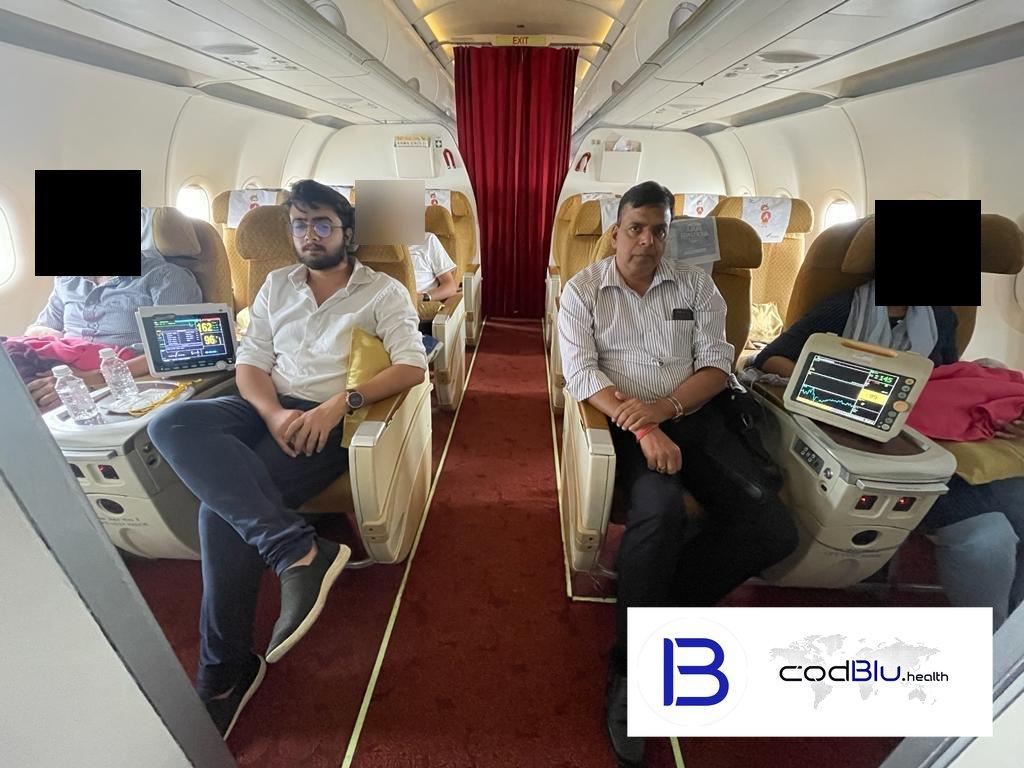
Commercial air ambulance services arrange medically supervised patient travel on scheduled passenger flights. Depending on clinical suitability and airline acceptance, patients travel as a wheelchair case or on an airline-approved stretcher. CodBlu Healthcare coordinates assessment, medical permissions, accompanying personnel, airport assistance and agreed ground transfers. This option may suit selected cancer patients with generalised weakness, patients with reduced mobility and others whose care can be accommodated during scheduled travel. Domestic transfers use nonstop flights without intermediate stops, layovers or flight changes. For 24/7 medical coordination, call +91 93108 64489.
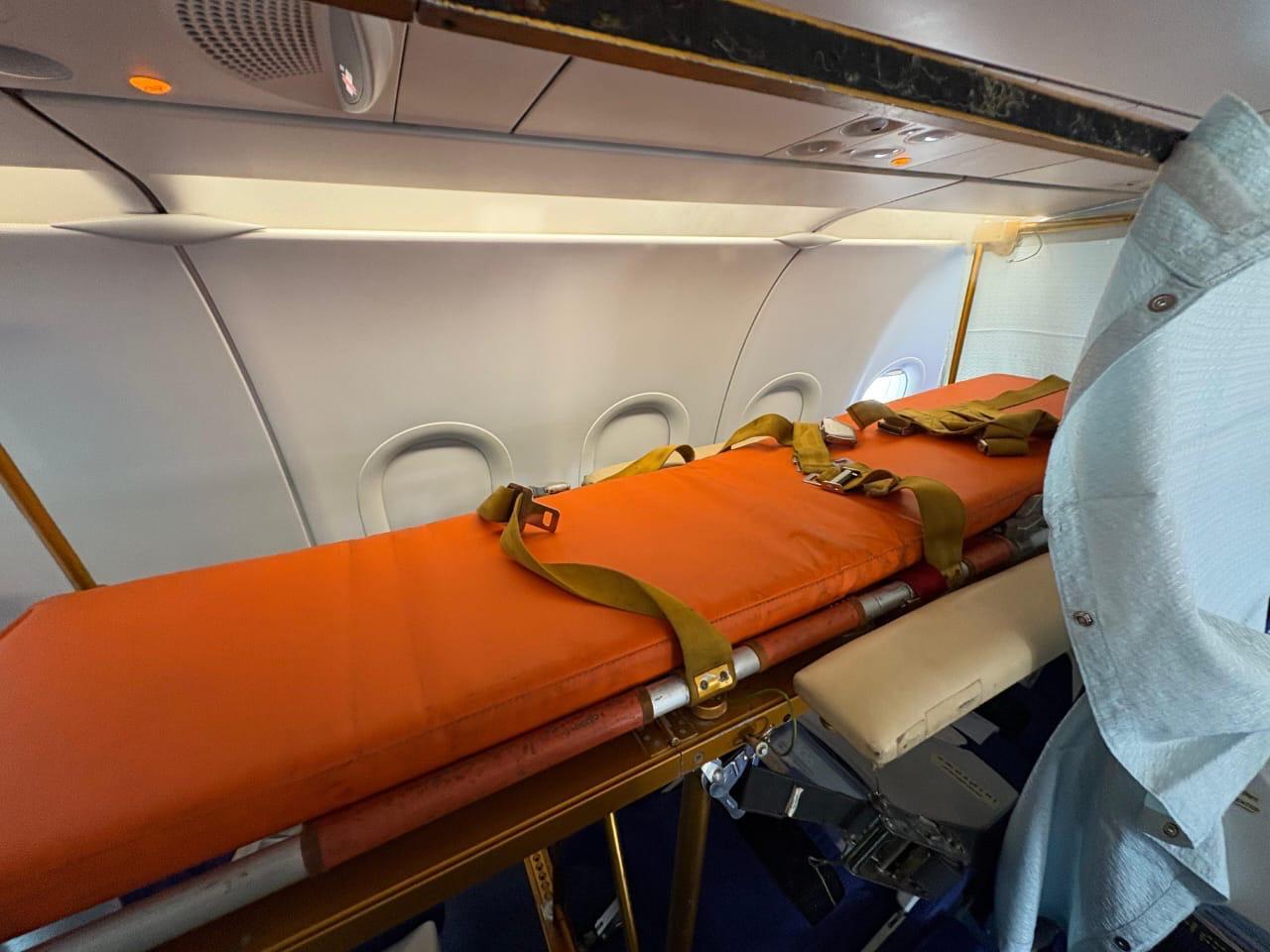
Wheelchair Case Transfer or Airline Stretcher?
Wheelchair Case Transfer with Medical Escort
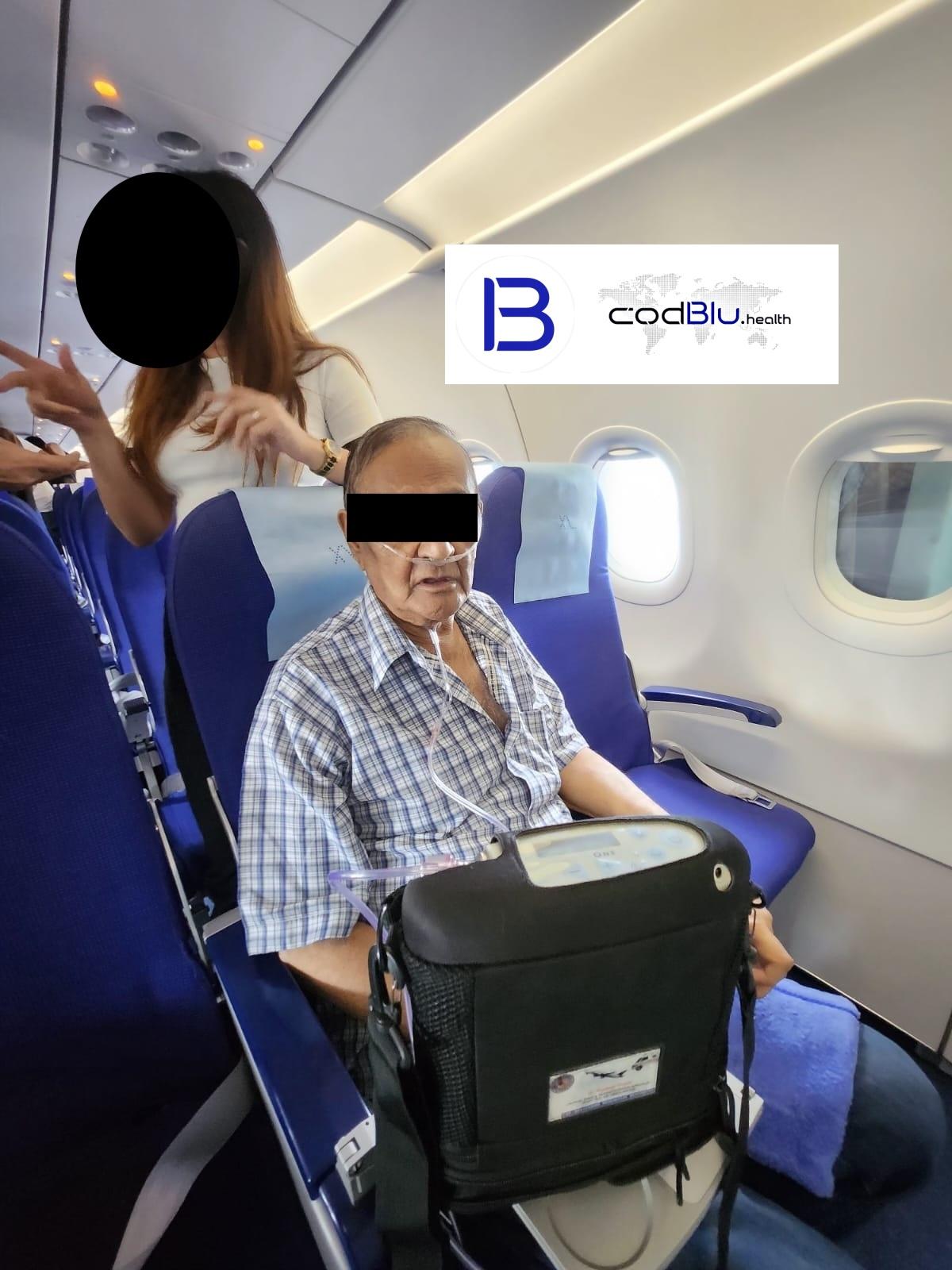
A wheelchair case transfer may suit a patient who needs assistance moving through the airport but can tolerate an approved aircraft passenger seat.
CodBlu coordinates wheelchair assistance, boarding and disembarkation support, an accompanying medical professional and any approved oxygen or equipment arrangements. Assistance reaching the aircraft seat is requested according to the patient’s needs and available facilities.
The patient transfers into an economy- or business-class seat for the flight. The choice depends on clinical suitability, seating configuration, availability and budget.
The assessment considers:
- Ability to sit upright when required, including take-off and landing.
- Assistance needed between the bed, wheelchair and aircraft seat.
- Pain, fatigue and tolerance of airport waiting.
- Medication, monitoring and personal-care requirements.
- Assistance needed during an emergency.
Independent walking is not essential for every wheelchair case. However, suitable positioning and the required assistance must be achievable throughout the journey.
Airlines record assistance using WCHR when the passenger can manage stairs and walk to the seat, WCHS when the passenger cannot manage stairs but can reach the seat, and WCHC when assistance is needed to the cabin seat. A stretcher passenger is recorded as STCR; MEDA identifies a medical case requiring clearance.
These codes describe assistance requirements, rather than establishing fitness to fly.
Commercial Airline Stretcher Transfer
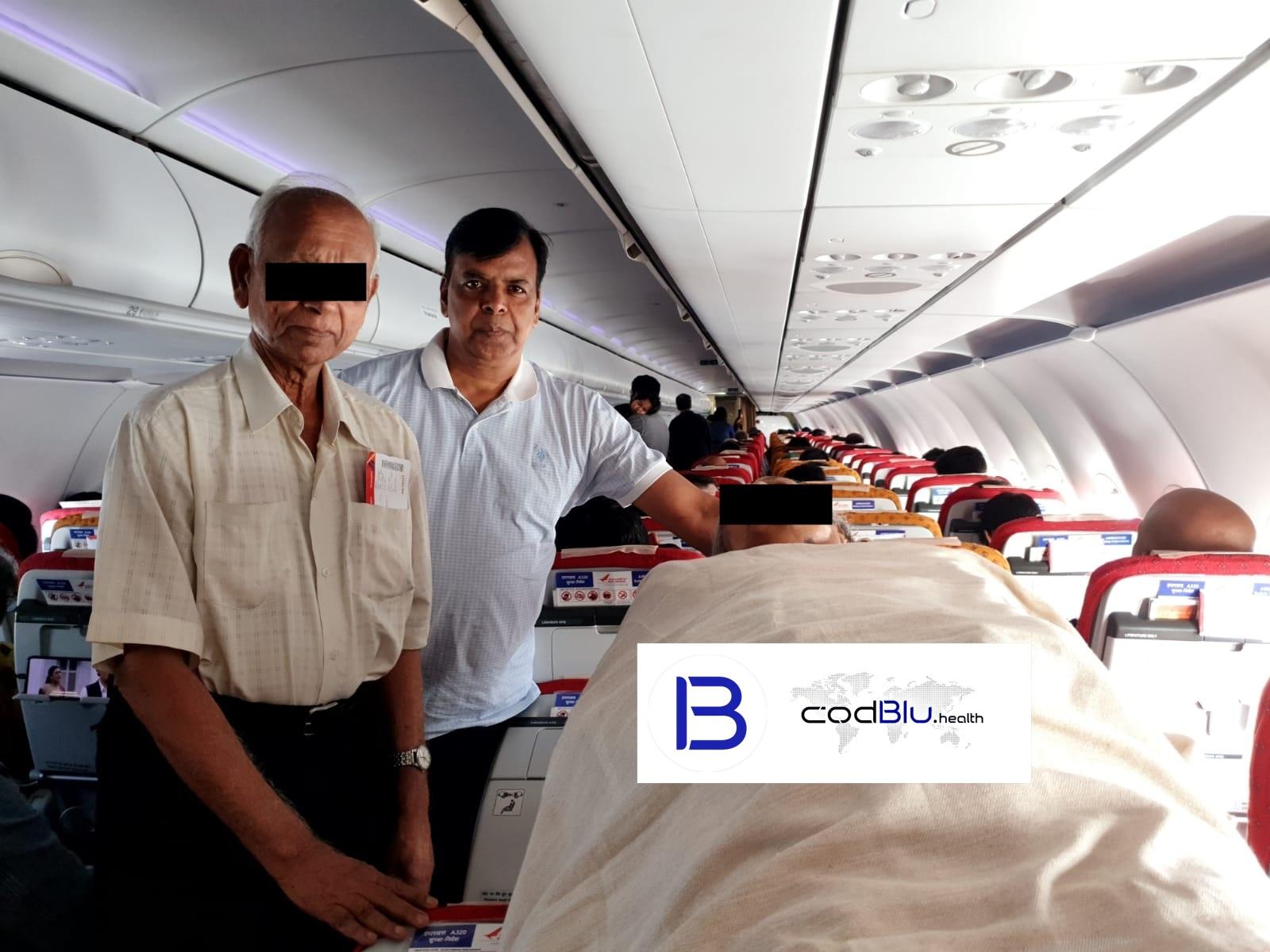
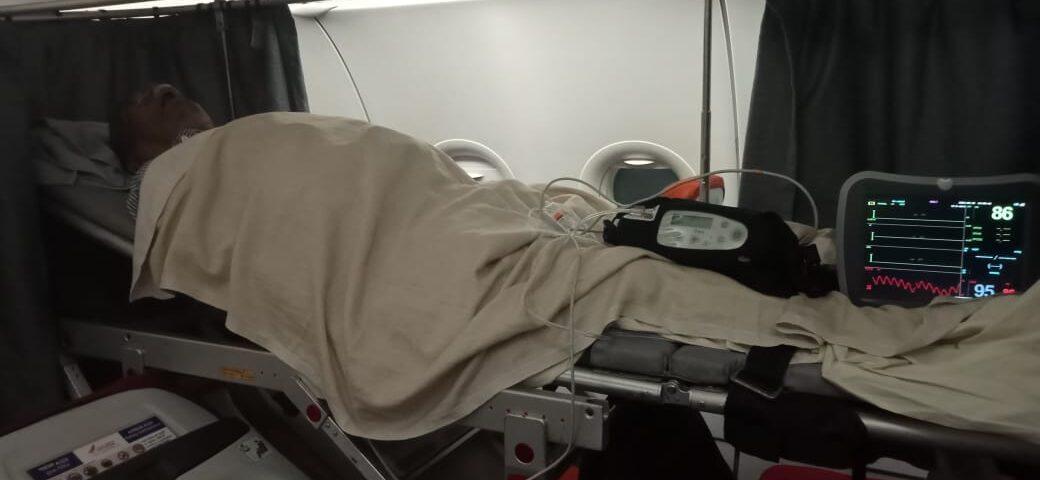
An airline stretcher allows an accepted patient to travel in an approved lying position within a designated area of the passenger cabin.
The arrangement requires medical clearance, a compatible aircraft, installation availability, suitable handling at both airports and an accompanying escort.
Medical personnel and equipment are selected for the patient’s condition and the airline’s permissions. A stretcher installation does not automatically provide the treatment facilities or working space of an intensive care unit.
A reclining business-class seat cannot replace an airline stretcher when the patient cannot tolerate the required sitting position.
Learn more about medical escort services.
Add CodBlu Healthcare as a Preferred Source

Airline Stretcher Requirements in India
IndiGo: Aircraft Eligibility and Seats Required
IndiGo’s published disability-assistance guidance lists stretcher provision on Airbus A320 and A321 aircraft. Its published stretcher service is unavailable on connecting flights.
The configuration folds six seats across three rows. Three adjoining aisle seats remain clear for access, resulting in charges for nine seats at the prevailing fare, plus a handling fee.
An ATR-operated flight does not qualify under this published stretcher provision. Wheelchair cases on regional aircraft require a separate assessment of access, seating and assistance.
The exact aircraft, stretcher installation and medical acceptance must be confirmed for the booking.
Read IndiGo’s official assistance guidance.
Air India: Stretcher Capacity, MEDIF and Accompaniment
Air India’s published stretcher requirements include:
- Travel on Air India-operated sectors, subject to availability.
- One stretcher case per flight.
- Stretcher accommodation in the economy cabin.
- A separate MEDIF for each flight sector.
- An accompanying non-disabled adult to attend to the patient’s needs.
The clinical assessment determines the appropriate medical escort. The adult-accompaniment requirement does not replace the need for a doctor or other medical professional where indicated.
Air India’s aircraft configuration and charges must be confirmed separately. IndiGo’s nine-seat arrangement should not be applied automatically to another airline.
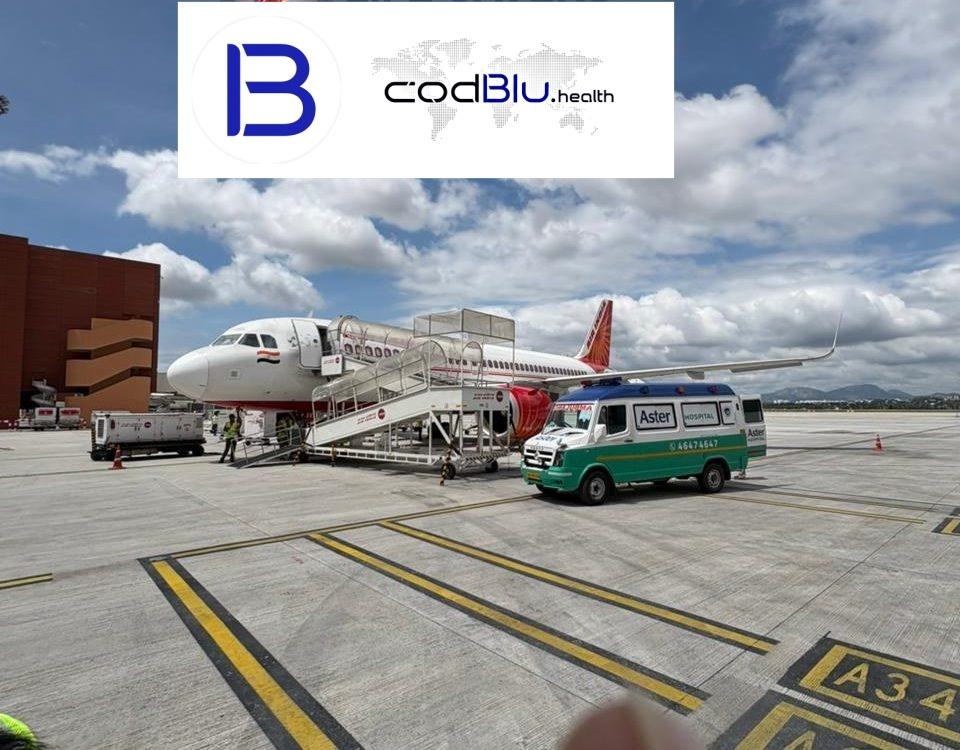
Airport Boarding, Ambulift and Airside Coordination
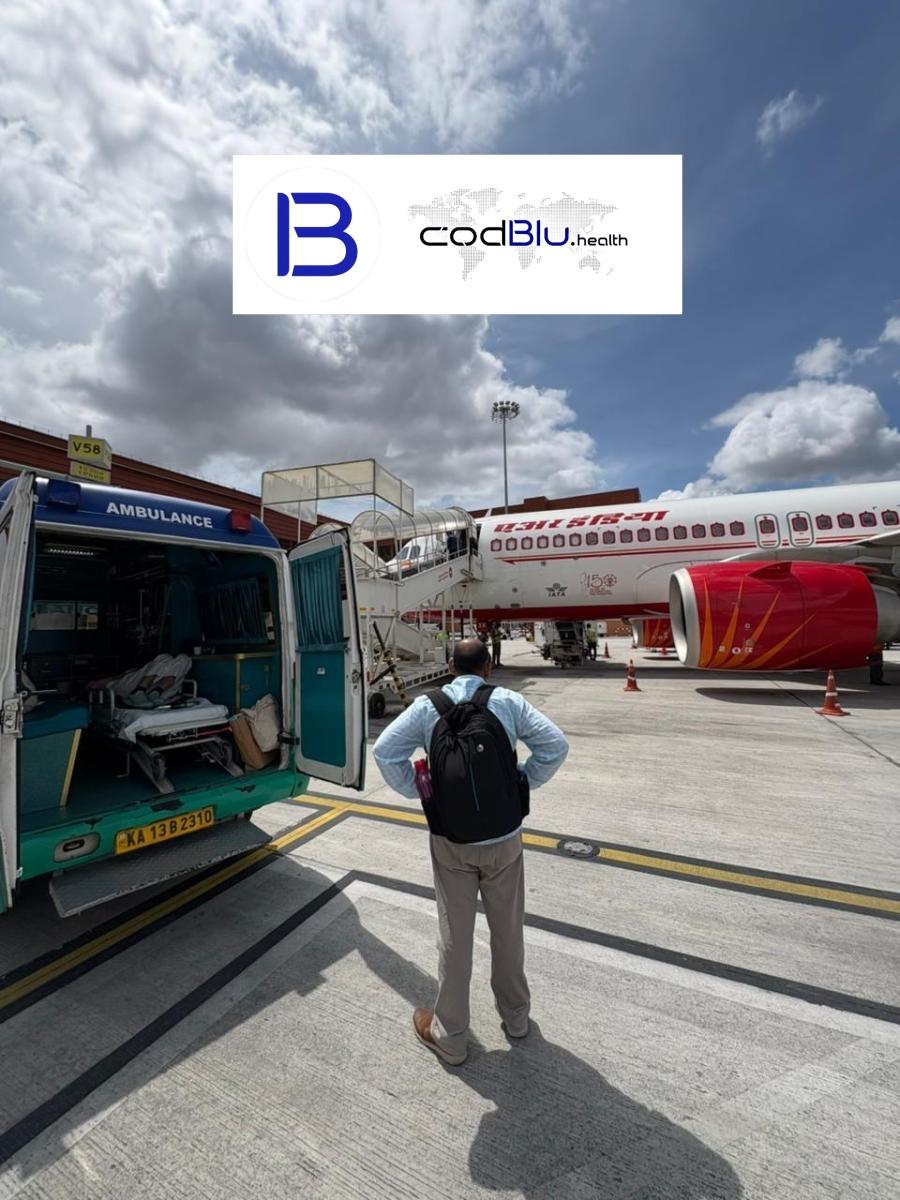
A stretcher booking also requires an approved plan for moving the patient into and out of the aircraft. Ordinary passenger boarding arrangements should not be assumed suitable.
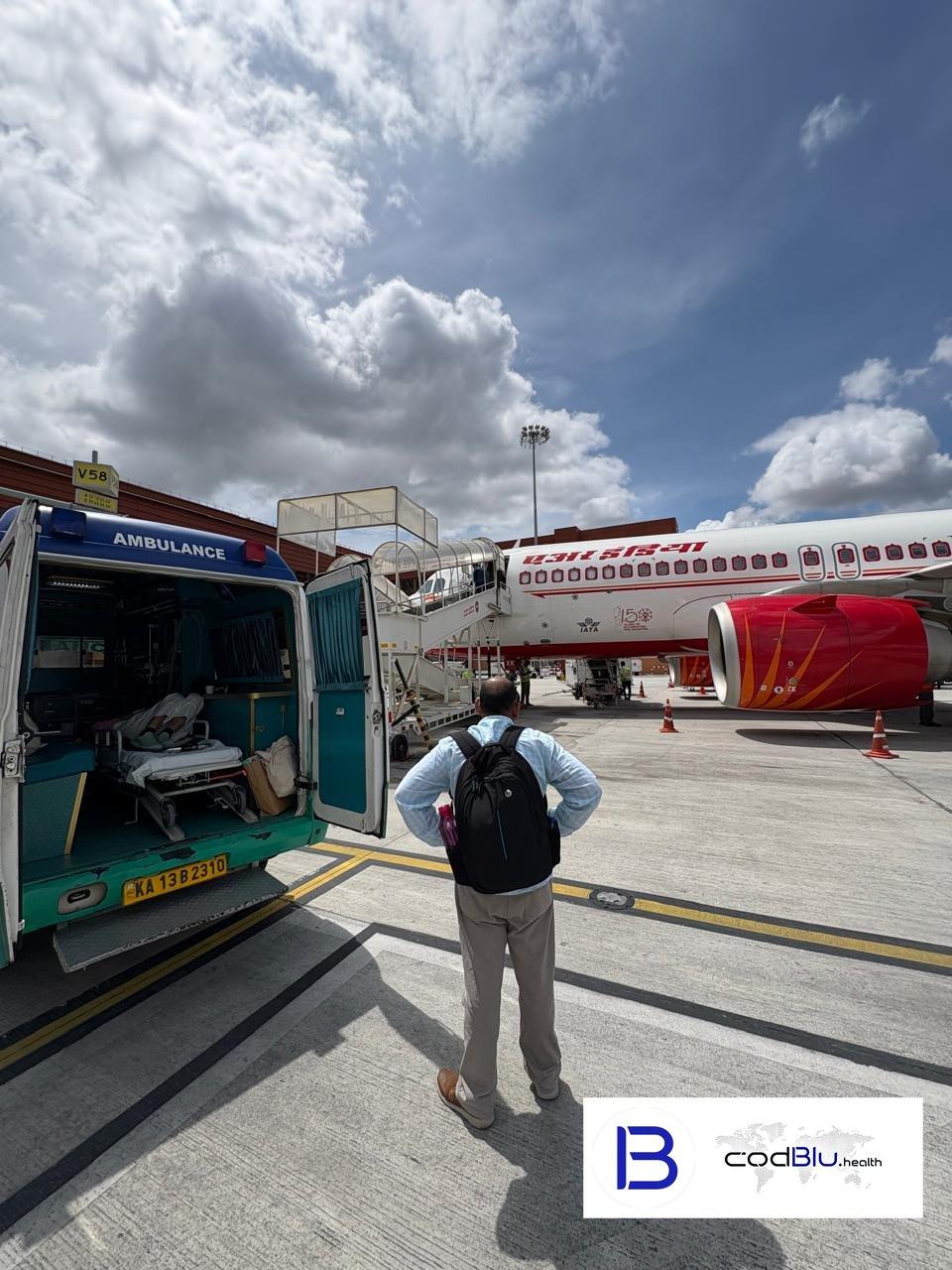
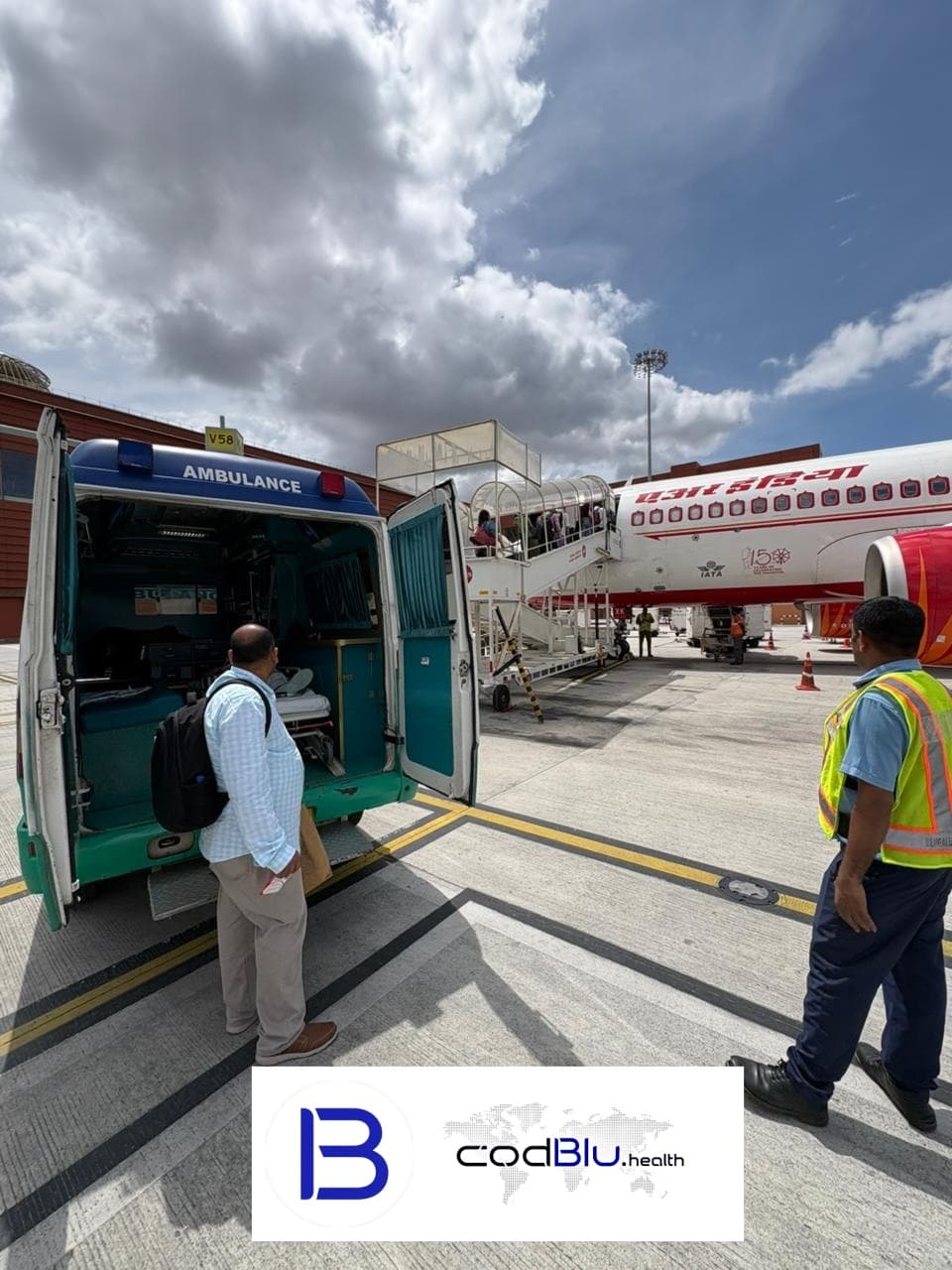
Depending on the aircraft, parking stand and airport facilities, boarding may involve an ambulift or another approved passenger-lifting arrangement, together with an authorised airside ambulance connection where required.
CodBlu coordinates these requirements with the airline, authorised ground handler and airport teams. Planning includes:
- Suitable boarding and arrival equipment.
- Trained personnel for patient movement.
- Required security and airside-access permissions.
- Continuity of oxygen, monitoring and prescribed support.
- Coordination between the ambulance, lifting equipment and aircraft.
Start these arrangements with the medical application. Published airline notice periods are a starting point; equipment availability and access approvals must be confirmed at both airports.
The written quotation specifies whether ambulift, airport handling and airside ambulance arrangements are included or charged separately.
Which Patients Can Be Considered for Commercial Medical Travel?
Dr. Deepshikhar Gupta or Dr. Pradeep Gupta personally performs the pre-transfer clinical assessment before the transport mode and medical team are finalised.
Potential candidates include selected patients with generalised weakness, reduced mobility, stable oxygen requirements or continuing care needs that can be accommodated within the approved arrangements.
| Assessment area | What needs to be established |
|---|---|
| Circulation | Stable blood pressure and circulation without an escalating need for treatment |
| Positioning | Ability to tolerate the required passenger-seat or approved stretcher position |
| Mobility and assistance | Safe assisted transfers, personal care and emergency assistance |
| Breathing | Stable respiratory condition with an adequate, approved support plan |
| Haemoglobin | CodBlu’s minimum screening criterion is 8 g/dL, with stricter airline requirements taking precedence |
| Continuing care | Necessary medicines, monitoring and support can be maintained throughout the journey |
| Receiving arrangements | Appropriate hospital acceptance or continuing care at home |
Meeting a screening criterion does not establish fitness to fly. Airline thresholds vary and can be stricter; the operating airline’s current medical guidance and MEDIF criteria apply.
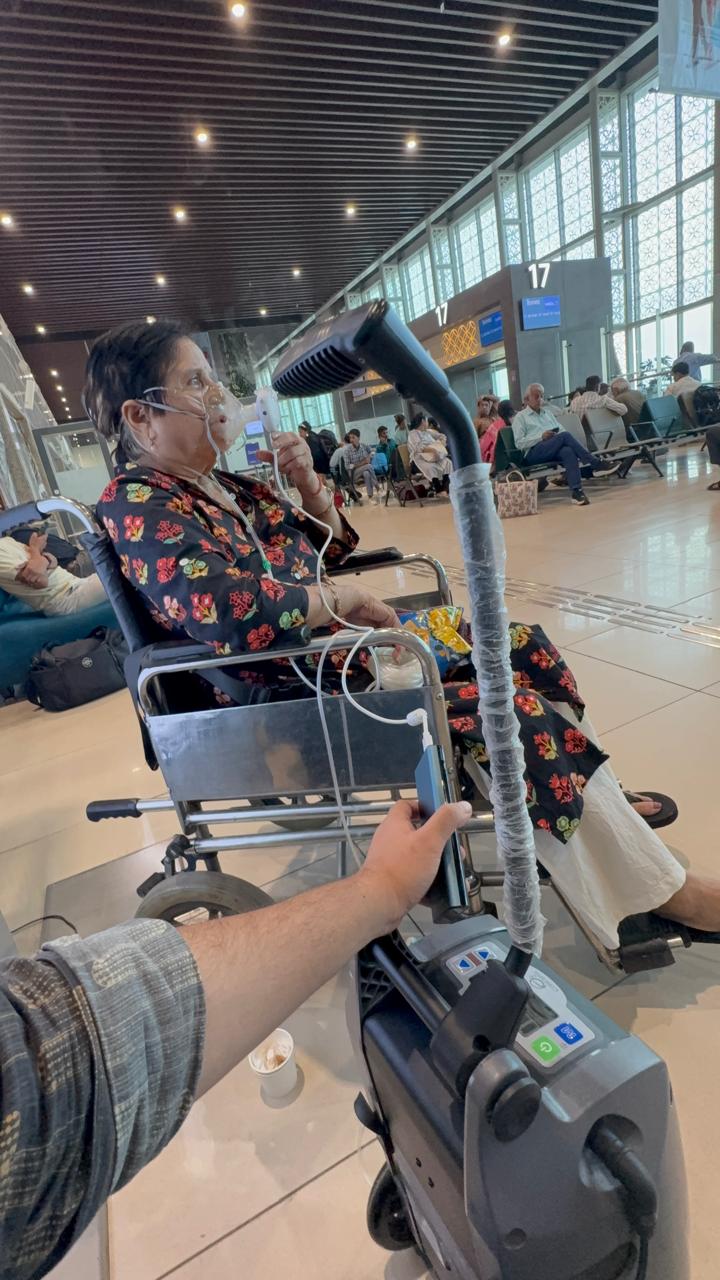
Patients Receiving 1–2 Litres of Oxygen per Minute
A stable patient receiving approximately 1–2 L/min of oxygen on the ground may be assessed for commercial travel.
The ground prescription cannot simply be assumed sufficient in flight. The assessment considers the underlying condition, oxygen saturation on prescribed support, response to movement and expected requirements under flight conditions.
Oxygen planning must cover ground travel, airport waiting, boarding, the flight and arrival.
Where a portable oxygen concentrator is proposed, its delivery mode and output must meet the prescription. A pulse-dose setting is not equivalent to the same number of litres per minute of continuous-flow oxygen.
Airline rules differ. IndiGo prohibits onboard oxygen cylinders and separately assesses approved portable oxygen concentrators. The proposed arrangement must be accepted before travel.
Tracheostomy Patients and Backup BiPAP
Selected stable tracheostomy patients may be considered after reviewing:
- Tube type, size and cuff status.
- Spontaneous breathing and dependence on respiratory support.
- Oxygen delivery and secretion management.
- Suction frequency and equipment requirements.
- Recent blockage, bleeding, displacement or deterioration.
- The accompanying clinician’s airway-care responsibilities.
Where BiPAP is proposed as backup, the prescribed indication, device, settings, interface, battery endurance and permitted use must be established.
A conventional mask arrangement cannot be assumed suitable for every tracheostomy patient. Support delivered through a tracheostomy requires assessment as ventilation through an artificial airway.
Continuous dependence on breathing support requires a different evaluation from carrying precautionary backup equipment. Describing a device as backup does not remove airline approval requirements.
When Another Transfer Plan May Be Needed
Worsening breathlessness, increasing oxygen demand, unstable circulation, active bleeding, serious infection or care requirements beyond the approved arrangements may make scheduled travel unsuitable.
A charter air ambulance may be considered where its medical configuration can support the patient. Some patients require further stabilisation before any flight.
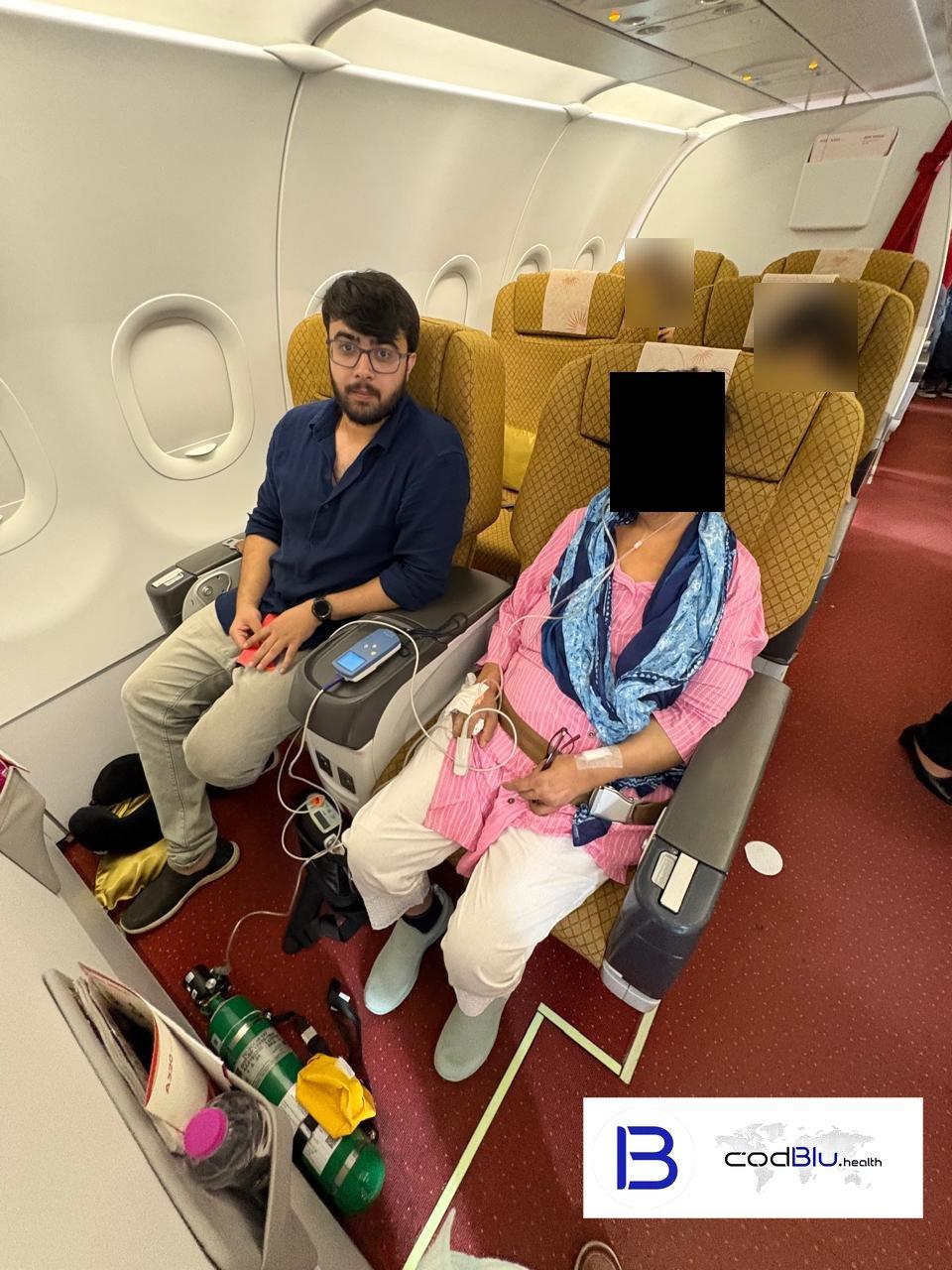
Commercial Air Travel for Cancer Patients with Generalised Weakness
Cancer treatment can leave a patient too weak to manage airport walking, queues and boarding independently. This does not automatically mean a private aircraft is required.
A medically suitable patient may travel as a wheelchair case with a medical escort, reducing exertion while receiving the agreed clinical supervision.
This may support travel for:
- An oncology consultation or further treatment.
- Recovery and rehabilitation after discharge.
- Return home with continuing medical care.
- A planned transfer to another oncology centre.
Weakness must first be assessed. Anaemia, dehydration, infection or treatment complications may change the recommendation.
The treating oncologist should advise on timing after chemotherapy, radiotherapy or surgery. Active treatment and complications can trigger airline restrictions; being between treatment sessions does not itself establish acceptance.
Cancer-care journeys may involve institutions such as Tata Memorial Hospital in Mumbai, Rajiv Gandhi Cancer Institute in Delhi, Apollo Cancer Centre in Chennai, Tata Medical Center in Kolkata, Basavatarakam Indo American Cancer Hospital in Hyderabad or HCG Cancer Hospital in Bengaluru.
The exact hospital campus, appointment or admission must be confirmed before travel. Hospital names are planning references and do not establish affiliation or guaranteed admission.
Domestic Commercial Transfers Use Nonstop Flights
CodBlu’s domestic commercial medical-transfer pathway uses a single nonstop flight without intermediate stops, layovers, flight changes or airport changes.
This limits additional boarding movements, transit waiting and changes in assistance or medical arrangements.
If no suitable nonstop service is available, the team assesses another departure airport or a different transport mode. Any additional road journey must be clinically acceptable.
A scheduled nonstop route establishes passenger connectivity. It does not confirm stretcher availability, medical acceptance or equipment permissions.
Domestic Route Planning by Departure Region
The following sectors can be assessed against the patient’s condition and proposed travel date.
These are nonstop passenger-route options for assessment, not confirmed stretcher services. IndiGo stretcher bookings require an approved A320/A321 configuration; ATR-operated flights do not qualify under its published stretcher provision. Air India applies its own aircraft and installation requirements.
| Departure region or hub | Nonstop sectors to assess |
|---|---|
| Northeast: Guwahati | Guwahati to Delhi; Guwahati to Kolkata; Guwahati to Ahmedabad |
| Upper Assam: Dibrugarh | Dibrugarh to Delhi |
| East: Patna and Ranchi | Patna to Delhi; Patna to Mumbai; Ranchi to Mumbai |
| East: Bhubaneswar and Kolkata | Bhubaneswar to Delhi; Kolkata to Chennai |
| Central India: Raipur | Raipur to Mumbai |
| North Bengal: Bagdogra | Bagdogra to Delhi; Bagdogra to Hyderabad; Bagdogra to Bengaluru |
| Delhi hub | Delhi to Mumbai; Delhi to Kolkata; Delhi to Bengaluru; Delhi to Chennai; Delhi to Hyderabad |
| Mumbai hub | Mumbai to Chennai; Mumbai to Kolkata; Mumbai to Varanasi; Mumbai to Thiruvananthapuram |
Patients from Siliguri and surrounding North Bengal areas may be assessed for departure through Bagdogra. District pickups elsewhere also require assessment of the first ground journey and continuing medical support.
Return travel requires a fresh check of clinical suitability, nonstop availability and airline acceptance.
How Much Advance Notice Is Required?
| Arrangement | Published airline notice guidance |
|---|---|
| IndiGo wheelchair assistance | Request at least 48 hours before departure |
| IndiGo medical cases | Submit medical information at least 72 hours before departure |
| IndiGo stretcher requests | At least 48 hours before departure, while also addressing applicable medical-submission requirements |
| Air India MEDIF arrangements | Its guidance asks for the MEDIF and recent supporting documents “up to five days before your departure”; confirm the submission deadline for the individual case |
For a wheelchair case involving oxygen or medical equipment, the medical-clearance requirements also apply.
Advance-notice requirements are not guaranteed approval or booking times. The achievable departure depends on complete records, airline decisions, crew arrangements, equipment permissions and availability.
IndiGo medical-information guidance · Air India MEDIF guidance
Commercial Air Ambulance Cost in India
| Domestic arrangement | CodBlu’s planning estimate |
|---|---|
| Wheelchair case transfer with medical escort | ₹40,000–60,000 |
| Commercial airline stretcher transfer | ₹3.5–5 lakh |
These indicative estimates vary with the route, airline, patient’s condition, medical support and travel arrangements.
A written quotation confirms the total cost, inclusions, exclusions and applicable terms before booking. International transfers require a separate quotation.
Details Required Before Booking
Please share:
- Current diagnosis and latest medical or discharge summary.
- Treating consultant’s contact details and travel recommendation.
- Recent vital signs, relevant investigations and haemoglobin result.
- Current medicines, allergies and recent clinical changes.
- Oxygen flow, delivery method and saturation on prescribed support.
- Sitting tolerance, mobility and assistance requirements.
- Tracheostomy, suction, BiPAP or other device details, where applicable.
- Patient identification and accompanying-person information.
- Pickup location, destination and preferred dates.
- Receiving-hospital acceptance or appropriate home-care arrangements.
Further investigations or equipment documentation may be requested after assessment. The treating physician completes the relevant medical declarations.
A fit-to-fly certificate supports the application. It does not replace airline medical acceptance where required.
How CodBlu Coordinates the Transfer
Share the patient’s records, location, proposed destination and support needs.
Dr. Deepshikhar Gupta or Dr. Pradeep Gupta assesses whether a wheelchair case, airline stretcher or another transport option should be explored.
The team checks the aircraft, assistance, stretcher installation, medical paperwork, boarding arrangements and equipment requirements.
Review the total price, agreed inclusions, additional expenses, payment terms and cancellation conditions.
Hospital release, ground transport, airport reporting, boarding assistance and receiving care are organised around the accepted itinerary.
Any deterioration requires reassessment. A previous approval should not be treated as continuing clearance after a material clinical change.
Cancellation, Deductions and Refunds
Patient tickets, medical crew tickets and airline stretcher bookings can have different cancellation conditions.
| Cancellation circumstance | Applicable deductions |
|---|---|
| Patient or attendant cancels | Actual non-recoverable ticket costs and the disclosed processing fee |
| CodBlu cancels | Actual non-recoverable ticket costs; no processing fee |
| Airline stretcher arrangement is cancelled | Airline stretcher-specific cancellation rules apply separately from ordinary passenger-ticket rules |
| Accommodation or other arrangements have been booked | Applicable supplier cancellation charges, as disclosed in the quotation |
The refundable balance is returned within 1–2 working days once applicable deductions and refundable amounts are established. Airline refunds remain subject to the airline’s processing timeline.
Air India’s published stretcher guidance states that cancellation charges do not apply to the stretcher request when cancelled at least 12 hours before domestic or SAARC departure, or 72 hours before international departure. This does not establish a refund for every separate ticket or service charge.
Inform the team immediately if medical postponement is needed so clinical arrangements and financial commitments can be reviewed.
Frequently Asked Questions
Yes, selected patients can be considered after assessment. The cause of weakness, treatment-related restrictions, sitting tolerance and required support must be addressed before airline acceptance.
It meets CodBlu’s minimum screening criterion but does not guarantee acceptance. Airline thresholds vary and can be stricter; the operating airline’s medical guidance and MEDIF criteria apply.
They can be assessed individually. Suitability depends on their condition, oxygen needs under flight conditions and the approved supply available throughout the journey.
Selected patients may be assessed. Airway care, device compatibility, the prescribed interface, escort capability and airline permissions must be confirmed. Continuous dependence on respiratory support requires a separate evaluation.
No. CodBlu’s domestic commercial medical-transfer pathway uses nonstop flights without intermediate stops or flight changes.
No. Some wheelchair cases require assisted mobility. Safe transfers, appropriate positioning, personal care and emergency assistance must still be achievable.
The airline and airport teams confirm an approved boarding method. Depending on the aircraft and facilities, this may involve an ambulift or another approved passenger-lifting arrangement, trained personnel and authorised airside transport.
Start at least 48 hours ahead for wheelchair assistance, allowing for 72-hour medical-submission requirements where applicable. Stretcher requests and Air India applications have their own notice requirements. Departure is confirmed for the individual case.
CodBlu’s domestic planning estimates are ₹40,000–60,000 for a wheelchair case with medical escort and ₹3.5–5 lakh for an airline stretcher transfer. The written quotation confirms the total cost and agreed scope for the actual journey.
This can be arranged subject to availability and airline rules. Family seating and the medical escort’s seating requirements must be checked separately.
Coverage depends on the policy, medical necessity, benefit limits and prior authorisation. Obtain written confirmation before assuming reimbursement.
The team may assess further stabilisation, a dedicated medical aircraft or, where clinically appropriate, a rail ambulance. Cross-border journeys require separate international medical repatriation planning.
Cross-border journeys: see international medical repatriation. Longer journeys for suitable patients: see rail ambulance.

Request a Commercial Patient-Transfer Assessment
Share the latest medical records, departure location and intended destination. CodBlu Healthcare will assess the appropriate arrangement and explain the required approvals, medical support and costs.
For 24/7 medical coordination, call +91 93108 64489 or request a transfer assessment.

