

Medanta, Delhi NCR to Apollo Hospitals, Guwahati | Rail Ambulance Transfer for an ILD Patient on Continuous Oxygen
Published on: October 29, 2026
A Long Journey with an Ongoing Oxygen Requirement
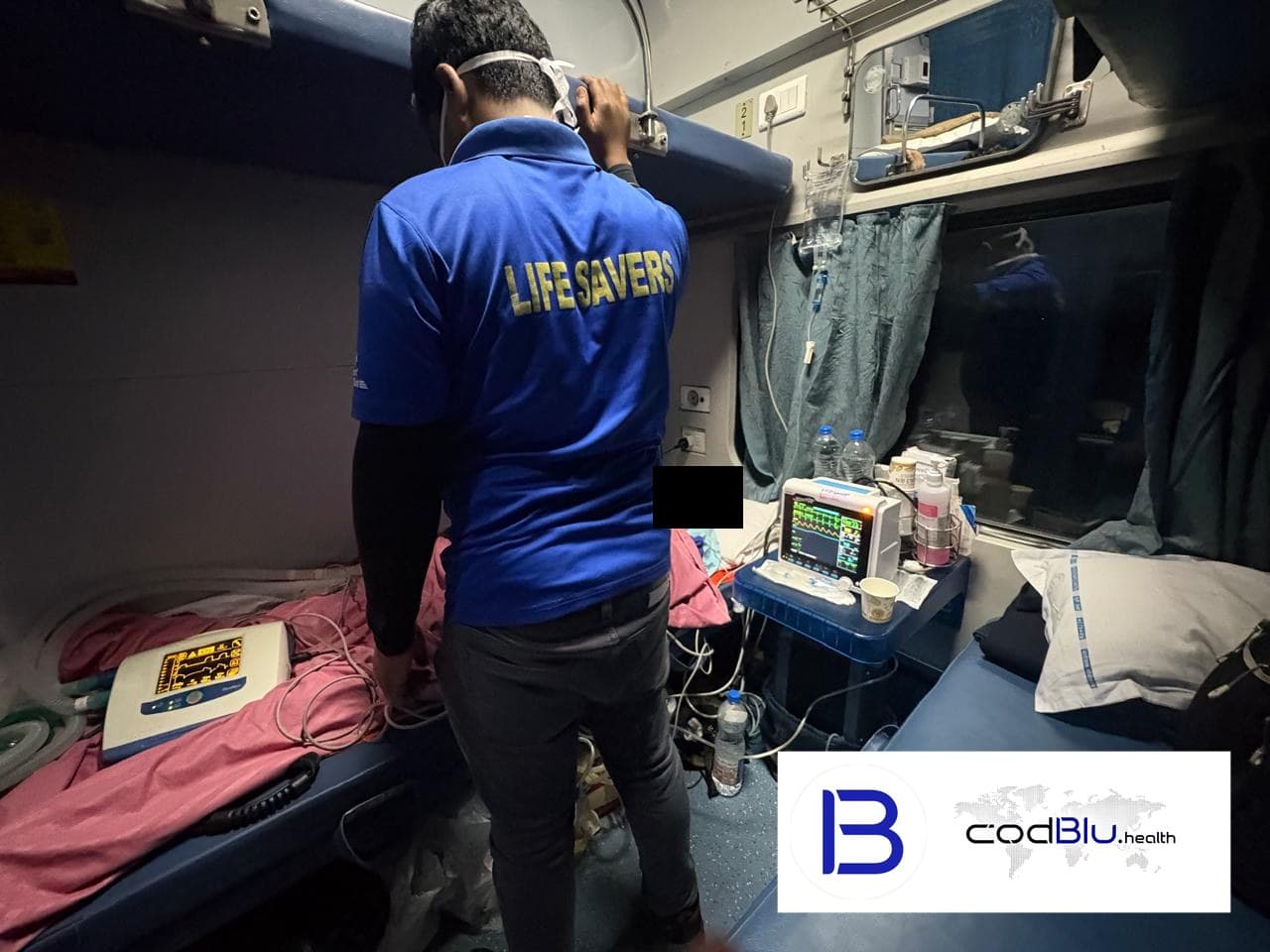
CodBlu Healthcare successfully transferred a 53-year-old man with interstitial lung disease from Delhi to Guwahati by rail ambulance. He required continuous oxygen at 1 litre per minute during the journey on the Dibrugarh Rajdhani Express.
The patient had interstitial lung disease, commonly called ILD, and needed continuous supplemental oxygen at 1 litre per minute. His medical relocation connected Delhi NCR with Guwahati, with oxygen continuity forming a central part of the transport requirement.
Although the prescribed flow was relatively low, the requirement was continuous. Planning therefore needed to account for the entire journey, including movement before boarding and after leaving the train.
The transfer was successfully completed to Guwahati. The case illustrates why the duration and reliability of respiratory support matter alongside the oxygen flow itself.
Understanding the Respiratory Needs of an ILD Patient
Interstitial lung disease describes a group of disorders that affect lung tissue. In many forms, inflammation or scarring can interfere with the movement of oxygen from the lungs into the bloodstream, contributing to breathlessness and reduced exercise tolerance. [1]
Patients with ILD can have different requirements at rest and during activity. Someone who appears comfortable while lying in bed may become more breathless during walking, repositioning or boarding.
For an ILD patient transfer, assessment should therefore consider recent symptoms, oxygen requirements, breathing effort and tolerance of movement. The diagnosis alone does not determine whether rail travel is appropriate.
In this case, the confirmed respiratory support was continuous oxygen at 1 litre per minute. No additional respiratory treatment is attributed to the patient.
Add CodBlu Healthcare as a Preferred Source

Continuous Oxygen at 1 Litre per Minute
An oxygen flow of 1 litre per minute describes the prescribed delivery rate. It does not establish the patient’s oxygen saturation or a fixed inspired oxygen concentration.
The patient’s response depends on the delivery device, breathing pattern and underlying lung condition. A low flow rate should therefore not be treated as evidence that oxygen can be interrupted.
For a prolonged rail journey, oxygen planning should cover:
- The expected duration of travel and possible delays.
- Ground connections and station waiting.
- Secure placement of the oxygen supply and tubing.
- Reserve capacity and arrangements for changing supplies.
- Reassessment if breathlessness or oxygen requirements increase.
Oxygen should be used according to the clinical prescription. Any adjustment during transport requires assessment rather than an assumption that the original flow will suit every stage of movement.
Travelling on the Dibrugarh Rajdhani Express
The patient travelled on the New Delhi–Dibrugarh Rajdhani Express, on the Delhi-to-Guwahati portion of its route.
A scheduled passenger train becomes part of a rail ambulance arrangement through the medical support organised for the individual patient. The train itself does not provide the resources of a hospital.
Preparation needs to consider patient access, berth arrangements, equipment placement, medicines and the ability to maintain prescribed treatment during travel.
For someone requiring continuous oxygen, boarding and disembarking deserve particular attention. These stages involve movement, changing surroundings and potential disruption to tubing or equipment. The oxygen system should remain accessible while allowing the patient to be handled comfortably.
Observation Throughout the Journey
Respiratory observation involves more than looking at an oxygen flow setting.
For a patient with ILD, relevant checks include oxygen saturation, respiratory rate, breathing effort, pulse and changes in responsiveness. Symptoms such as increasing breathlessness or difficulty tolerating movement should be considered alongside measured observations.
A baseline assessment before departure helps the medical team recognise changes during travel. Equipment readings also need interpretation in context; a single number cannot describe the patient’s complete respiratory condition.
Positioning, rest and assistance with movement may help reduce unnecessary exertion. These are general considerations for oxygen-supported transport, rather than claims about specific interventions performed during this mission.
Completing the Delhi-to-Guwahati Transfer
The rail journey was one part of the wider relocation. Transfers between the hospital, ground vehicle, station and railway berth need to preserve access to prescribed oxygen.
At the destination, clinical communication should include the ILD history, oxygen prescription, current medicines and relevant transport observations. This helps the next care team understand the support already in place.
CodBlu’s rail ambulance services page explains how medical requirements, train arrangements and destination coordination contribute to a planned journey.
The patient’s transfer to Guwahati was successfully completed. The confirmed outcome is completion of the medical relocation, without making assumptions about subsequent improvement in his lung disease.
Questions About This Case
Can an ILD patient on continuous oxygen travel by train?
Selected patients can travel after individual medical assessment, provided their oxygen and other care requirements can be supported throughout the anticipated journey.
What oxygen support did this patient require?
He required continuous supplemental oxygen at 1 litre per minute.
Which train was used?
The patient travelled on the Dibrugarh Rajdhani Express.
Clinical References
[1] National Heart, Lung, and Blood Institute (NHLBI), NIH. Interstitial Lung Diseases.
Need Emergency Ambulance?
CodBlu Healthcare operates 24x7 across India — air, rail & road.
Call 24x7: +91-9310864489